

How does the brain distinguish imagination from reality?
“The imagination is not a state, it is the human existence itself” –
William Blake
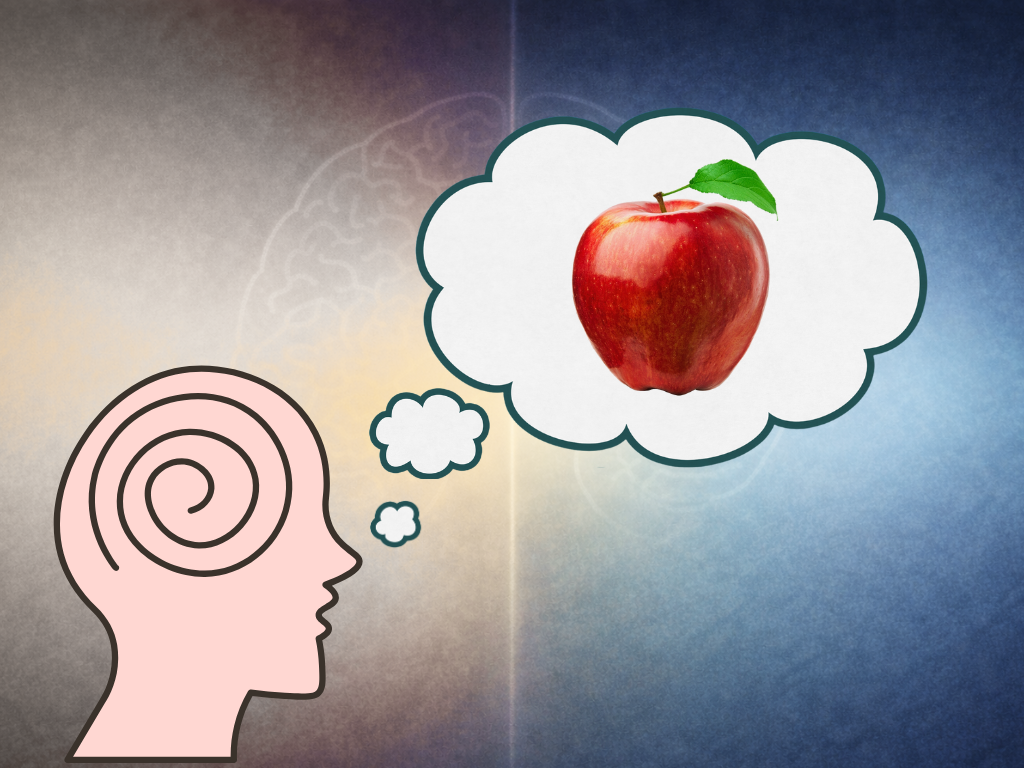
Close your eyes and imagine an apple on your kitchen table.
You can picture its shape, its color, maybe even the shine of its skin. The image might feel surprisingly real.
And yet, you know there is no apple there.
What is strange is that imagining the apple and actually seeing the apple activate many of the same areas in the brain.
So how does the brain know the difference between something that is real and something that is only imagined?
This question has fascinated neuroscientists for decades.
The old idea: a hidden “reality tag”
For a long time, researchers assumed that the brain must label experiences with some kind of distinctive marker (like a “reality tag”): “this came from the outside world” versus “this was generated internally“.
After all, the origin of the signal does differ.
Reality begins with external sensory input, such as light hitting the eyes or sound waves reaching the ears, while imagination is generated internally, drawing on memory and prediction.
According to this view, even though perception and imagination share brain areas, real experiences would carry a special neural signature that imagined ones lack.
However, despite decades of research, convincing evidence for a dedicated neural “reality tag” never emerged. Instead, it has been suggested that judgments of reality arise from the integration of multiple interacting features, including sensory detail, contextual information, prior knowledge, and the cognitive effort involved in generating the experience.
A different approach
Instead of asking how imagination and reality differ, a more recent study asked a simpler question: what makes an experience feel real?
In an fMRI study, participants either saw a very faint visual pattern on a screen or were asked to imagine the same pattern as vividly as possible.
After each trial, they had to say whether they thought the experience was real or imagined and how vivid it felt.
The key detail is that the real images were deliberately made very weak and sometimes, a strong imagination felt more vivid than actual perception.
This allowed the researchers to focus on people’s subjective judgments, not just on what was physically shown.
What the study revealed
The study revealed that the brain patterns produced by imagination and perception were not categorically different, but differed mainly in strength.
Both imagined and real images activated the same visual areas. Real perception usually produced a stronger and clearer signal, while imagination tended to produce a weaker and noisier one. However, this distinction was not absolute. When imagination was especially vivid, its neural signal could match or even exceed that of weak real perception.
Participants’ judgments followed subjective vividness rather than objective reality.
As a result, strong imagination was sometimes reported as real, while weak perception was sometimes dismissed as imagined.
In short, reality judgments were based on how strong the experience felt, not simply on what physically occurred.
How is this judgment made?
Two different parts of the brain are mainly implied.
Sensory and associative visual regions (such as the visual cortex and the fusiform gyrus in the temporal lobe) are responsible for generating the experience itself. Whether you are seeing apples on a table or imagining them, these regions produce a visual signal that reflects how strong and detailed the experience is.
The judgment comes later, from regions in the prefrontal cortex. These areas are involved in evaluation and confidence. Rather than asking, “Was this caused by light hitting the eyes?”, they ask questions like: “How strong was that signal? How confident am I? Does this cross my threshold for being real?”
This process is known as metacognition, or thinking about your own mental states.
What this means is that activity in prefrontal regions was correlated with participants’ subjective judgments of reality rather than with the objective presence or absence of an external stimulus.
The takeaway: Reality is interpreted, not tagged
The brain does not tag experiences as “real” or “imagined.” Instead, it evaluates reality from signal strength.
Summarizing, first visual regions generate an experience that can range from faint to vivid. Then the prefrontal cortex evaluates that signal. If it is strong enough, the experience is classified as real. If it is weak, it is dismissed as imagination.
This mechanism helps explain why people with vivid imagery can feel as if their thoughts are real and why hallucinations, which are internally generated signals that are unusually strong, can be utterly convincing.
From the brain’s point of view, reality is not a binary switch, it is a probability judgment based on how strong an experience feels.
The same framework may explain why some dreams feel more real than others
During dreams, especially in REM sleep, sensory areas such as the visual cortex can generate very strong, perception-like signals. At the same time, the prefrontal systems that normally evaluate and question those signals are less active.
Since the brain decides what is “real” based on vividness and confidence rather than origin, some dreams feel completely real while others feel faint or unreal. The difference reflects how strong the internally generated signals are and how much reality-checking is happening at the time.
📖 References:
- Jon S. Simons, Jane R. Garrison and Marcia K. Johnson (2017). Brain mechanisms of reality monitoring. Trends in Cognitive Sciences.
- Nadine Dijkstra, Thomas von Rein, Peter Kok and Stephen M. Fleming (2025). A neural basis for distinguishing imagination from reality. Neuron