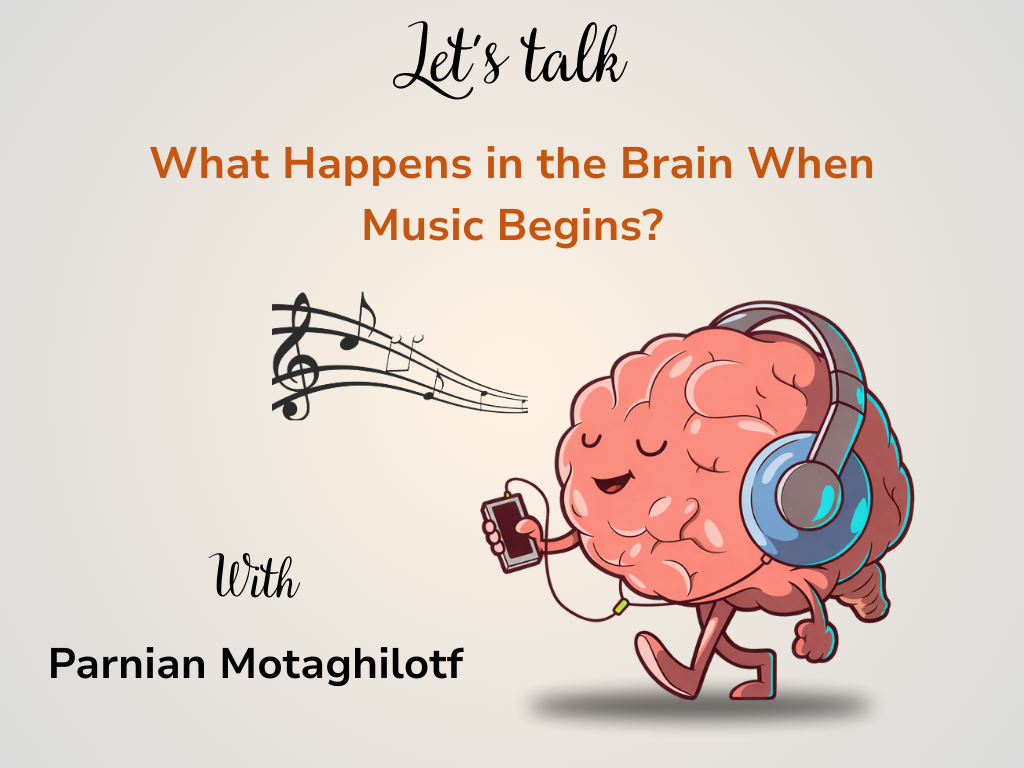
What Happens in the Brain When Music Begins?
“Music is a perceptual illusion, albeit a beautiful one.” –
Daniel Levitin
Parnian Motaghilotf
Music feels simple. You press play, sound fills the room, and something shifts.
But inside the brain, listening to music is not that simple.
It is not a passive experience.
The brain doesn’t just receive music; it builds it, moment by moment.
Sound is only the beginning
Everything starts as vibration. Sound waves enter the ear, are transformed into electrical signals, and are sent to the brain. At this early stage, the brain has no idea whether those signals belong to music, speech, or noise.
What happens first is that the brain tracks the basics: pitch, timing, and volume.
Later, the experience begins to feel like a song.
This is a crucial insight: music does not exist fully in the outside world.
It is something the brain actively constructs.
As neuroscientist Daniel Levitin put it: “Music is a perceptual illusion, albeit a beautiful one”.
There is no “music center” in the brain
Unlike some popular diagrams suggest, the brain does not have a single area that is dedicated to music.
Instead, listening to music recruits many systems at once:
- auditory regions that analyze sound features
- timing systems that track rhythm
- memory-related processes that recognize patterns
- attention networks that follow changes over time
This is why music is so interesting to neuroscientists.
It reveals how different parts of the brain coordinate with each other rather than work in isolation.
The predicting brain
One of the most important things the brain does while listening to music is prediction.
As soon as a rhythm starts, the brain begins to guess when the next beat will arrive, how a melody might continue, and whether a pattern will repeat or change.
Most of this happens outside awareness. You don’t consciously calculate what comes next. Your brain does it for you.
When music follows expectations, the brain stays comfortable and relaxed.
When music violates them, attention increases.
This same prediction machinery is used for language, movement, and perception in everyday life. Music simply makes it easier to notice.
Music unfolds over time, as the brain does
Unlike an image, music cannot be grasped at a single glance. It exists only as it moves forward in time.
To make sense of it, the brain must stay continuously engaged. It briefly holds on to what has just been heard, compares it with what is happening now, and adjusts its understanding as new sounds arrive.
Listening to music is therefore not a static act, but a continuous process.
The brain is always slightly catching up to the sound while preparing for what might come next.
How music helps us understand the brain
Neuroscientists don’t study music only because it is enjoyable.
They study it because music brings together many core functions of the brain at once, making it a useful model system for studying complex brain dynamics.
Music is structured, with patterns in rhythm and melody, yet flexible as it unfolds over time. It is universal across cultures, but endlessly variable in form. It is easy to hear, but complex to process.
Listening to music requires the brain to track time, recognize patterns, anticipate what comes next, and coordinate information across different systems, all continuously, without pause.
By observing how the brain listens to music, researchers gain insight into a more general question: how the brain organizes changing information, such as notes and rhythm, into meaningful experience?
A closing reflection
The next time you listen to a song, notice how uncomplicated the experience feels.
The sound flows, the rhythm carries you forward, and listening feels almost effortless.
However, that effortlessness is not the absence of work. On the contrary, without any apparent effort, the brain is constantly interpreting sound, predicting what might come next and adjusting its expectations as the music unfolds.
None of this requires deliberate attention or conscious intention. It happens quietly, in the background, as part of how the brain makes sense of the world.
Music does not simply enter the brain. It gives the brain something to do.
And in doing so, it offers a small but revealing insight into the mind itself, not as something static, but as something continuously active, shaping experience over time.